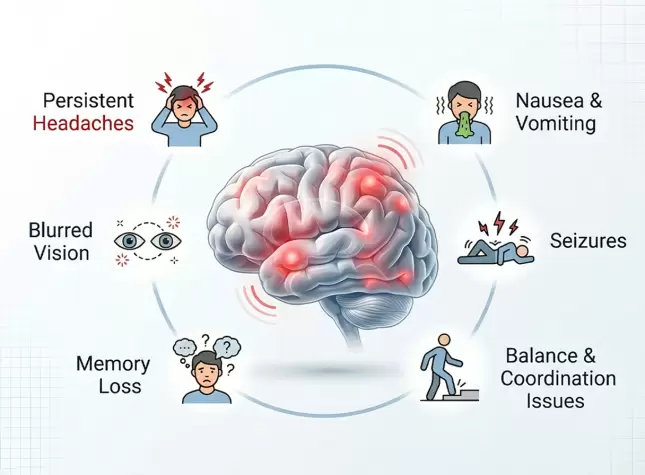
Are you searching for “What are the symptoms of a brain tumor?" Here are the general signs and symptoms:
- Headache or pressure in the head worsening in the morning
- Frequent severe headaches
- Nausea or vomiting
- Eye problems, such as blurry vision, seeing double, or losing sight on the sides of the vision
- Seizures
- Trouble thinking, speaking, or understanding language
- Facial numbness or tingling
- Weakness or paralysis in one part or one side of the body
- Confusion and disorientation
While not all brain tumors are cancerous, both benign and malignant tumors can cause serious health issues based on their size and location. It’s important to consult experts at a neurology hospital in Kolkata if you’re experiencing these symptoms.
Read Also: Your Guide to the Best Neurosurgeons in Kolkata for Brain & Spine Surgery
Types of Brain Tumor
It can be classified into two types:
- Primary vs. secondary
- By cell of origin / major type
Primary Brain Tumor
Brain tumors that start in the brain are called primary brain tumors.
Secondary Brain Tumor
Tumors that spread to your brain after forming in a different part of the body are known as secondary tumors, or metastatic brain tumors.
| Category |
Type of tumor (examples) |
Brief description |
| Primary |
Glioblastoma (GBM) |
These tumors form in glial cells called astrocytes and are the fastest-growing astrocytoma. |
| Primary |
Low‑grade astrocytoma / pilocytic astrocytoma |
Usually slow‑growing, often benign or low‑grade glioma. |
| Primary |
Oligodendroglioma (low‑grade or anaplastic) |
These uncommon tumors begin in cells that create myelin (oligodendrocytes, a layer of insulation around nerves in your brain). |
| Primary |
Ependymoma |
From ependymal cells lining ventricles; usually low‑grade. |
| Primary |
Meningioma |
From meninges; usually benign, slow‑growing. |
| Primary |
Pituitary adenoma |
From pituitary gland; often benign but hormonally active. |
| Primary |
Schwannoma (including acoustic neuroma / vestibular schwannoma) |
From Schwann cells of cranial nerves; usually benign. |
| Primary |
Pineocytoma / pineoblastoma (pineal‑region tumors) |
Pineocytoma: benign; pineoblastoma: malignant. |
| Primary |
Medulloblastoma |
Embryonal tumor, usually in cerebellum; common in children, malignant. |
| Primary |
CNS lymphoma |
Malignant lymphoma arising within the brain. |
| Secondary (metastatic) |
Brain metastases from lung, breast, melanoma, renal, colon, etc. |
Tumors spreading to brain from cancers elsewhere; often multiple lesions. |
By Cell of Origin / Major Type
| Group / origin |
Common subtypes (examples) |
| Gliomas (from glial cells) |
Approximately 78% of cancerous primary brain tumors are gliomas.
Astrocytoma, glioblastoma (GBM), oligodendroglioma, ependymoma. |
| Non‑glial (meninges, nerves, glands) |
Meningiomas, schwannomas / acoustic neuroma, pituitary adenomas, craniopharyngiomas, pineal tumors (pineocytoma mostly benign, pineoblastoma malignant), choroid plexus tumors (benign choroid plexus papilloma, malignant choroid plexus carcinoma). |
| Embryonal tumors |
Medulloblastoma, other CNS primitive neuroectodermal tumors (PNET). |
| Germ‑cell tumors |
Intracranial germ‑cell tumors (e.g., germinoma, teratoma). |
| Neuronal / mixed neuronal‑glial |
Gangliogliomas, gangliocytomas, anaplastic gangliogliomas. |
| Structural (skull base, bone, vessels) |
Chordomas, glomus jugulare tumors. |
| Lymphoid origin |
Primary central nervous system lymphoma (PCNSL). |
| Secondary / metastatic |
Metastases from lung, breast, melanoma, kidney, colon, etc. |
Read Also: Traumatic Brain Injury (TBI): Signs, Treatment, and Life After Injury
Early Stages of Brain Tumor
Neurologist in Kolkata at IRIS Multispecialty Hospital say early stages of a brain tumor, symptoms are often mild, nonspecific, or slowly progressive. Hence, they can be mistaken for stress, migraine, or “normal aging.” Therefore, always consult your doctor for an accurate diagnosis if symptoms persist.
How to Detect Brain Tumor at Home
Malignant (cancerous) or benign (noncancerous) brain tumors cannot be detected at home, as their diagnosis requires imaging (MRI/CT scans).
These are the actions that you can take at home:
- Keep a symptom diary, such as
- Weakness.
- Difficulty walking.
- Problems with balance.
- Partial or complete loss of vision.
- Trouble understanding or using language.
- Memory issues.
- Monitor worsening symptoms
- Do not self-diagnose
Read Also: Top Neurosurgeons In Kolkata: Expertise You Can Trust
What Are the Symptoms of a Brain Tumor
Here is the list in tabular manner:
| Type of symptom |
Typical signs and features |
| Headaches |
Often worse in the morning, may worsen on lying down, bending, or coughing; may not improve with routine painkillers. |
| Nausea and vomiting |
Frequently associated with headaches; may be more noticeable in the morning. |
| Seizures |
New-onset fits or unusual jerking/loss of awareness, especially in adults with no prior history. |
| Weakness or numbness |
One‑sided weakness, numbness, or clumsiness in arm, leg, or face (often focal). |
| Balance and coordination |
Dizziness, imbalance, stumbling, or difficulty walking. |
| Vision problems |
Blurred vision, double vision, loss of part of the visual field, or drooping eyelid. |
| Speech and language issues |
Difficulty speaking, slurred speech, trouble understanding others, or sudden reading/writing problems. |
| Memory and thinking change |
Forgetfulness, confusion, poor concentration, slowed thinking, or disorientation. |
| Mood and personality shift |
Sudden mood changes, irritability, depression, anxiety, or disinhibited/inappropriate behavior. |
| Sensory changes |
Tingling, odd sensations, or loss of smell on one side; facial numbness or tingling. |
| Fatigue and drowsiness |
Unexplained tiredness, excessive sleepiness, or reduced alertness. |
| High‑pressure‑type signs |
Worsening headaches plus nausea/vomiting, papilledema (swelling of the optic disc), and lethargy indicating raised intracranial pressure. |
Read Also: Concussion: Causes, Symptoms, and Recovery
Diagnosis of Brain Tumor
Experts at the neurology hospital in Kolkata use the following diagnostic tests for accurate analysis:
- Brain MRI or CT scan
- Biopsy
- Spinal tap (lumbar puncture)
- Specialized tests to check tumor markers
What are My Risk Factors for Brain Tumor
In most cases the cause isn't clear however, the following factors can increase the risk:
- Age
- Race
- Exposure to radiation
- Inherited syndromes that increase the risk of brain tumor. Examples include the DNA changes that cause neurofibromatosis 1 and 2, tuberous sclerosis, Lynch syndrome, and Li-Fraumeni syndrome
Conclusion
If you ask, “Are brain tumors curable?” Yes and no, but treatable based on the type, grade, location, and whether they are benign or malignant. Benign (noncancerous) brain tumors can generally be successfully removed with surgery and don’t usually grow back. The key is early detection and treatment.
Healthcare providers often use a combination of therapies to treat a tumor. Your treatment options might include:
- Watchful waiting/active surveillance (if you have a brain tumor that’s very small and isn’t causing symptoms)
- Brain surgery (craniotomy)
- Radiation therapy
- Radiosurgery
- Brachytherapy
- Chemotherapy
- Immunotherapy
- Targeted therapy
Looking for the best brain tumor treatment in Kolkata, India? Schedule a call at +91 8929579509.
Our Address: 82/1, Raja S. C. Mullick Road, Kolkata 700047 Open: 24x7, with 4.5 star review from 7,295 google reviews
FAQs
Q1: What is a Stage 1 brain tumor?
A: Also known as Grade I brain tumor, which means the tumor grows that slowly and rarely spreads into nearby tissues. It might be possible to entirely remove the tumor with surgery.
Q2: Are brain tumors curable?
A: Yes, they are treatable based on the type, grade, location, and whether they are benign or malignant. If your signs of brain tumor (headaches, seizures, numbness, etc.) persist go for early diagnosis.

 IRIS
IRIS
 Address: 82/1, Raja S. C. Mullick Road, Kolkata 700047
 Open: 24x7
 +91 8929579509